Sunday, March 16, 2008

Peter Grimes Lives in My Basement


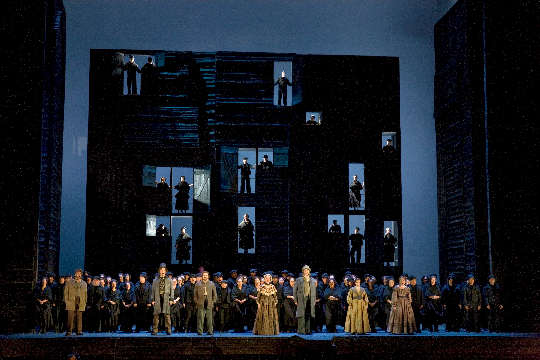
So I spent my spring break mildly depressed and sleep depraved. But beyond these silly suicidal theatrics, I managed to score free tickets to a live high definition broadcast of a Met Opera. I'm a loser of the squared degree, but I was well tuned for the occasion, and blown away by an opera that my tiny mind can only partially compute.

Walking out of Peter Grimes, I was struck at how desperate and bleak a thing I'd just seen. The darkness of the opera had swallowed me, and the brightness of the food court was like coming to the surface too quickly. All of the noise and people were too much; I wanted to scream, and for Benjamin Britten's piercing score to pour out my mouth, shaking the souls of the people eating their fast food. But alas, the only way out is down: for me, the escalators, but for Grimes, a death that plunged him into the deep giant abyss that surrounds our lives. And there is no hope, only the fatal delusion that we can change it.

Maybe I'm being a bit too grim for my own good, because the fatalism of Grime's libretto is offset by a score that is as alive as the sea, rising, breaking, and shattering the nerves like the worse case of sea-sickness. It almost acts as a substitute for that very object that can't ever be recreated, only represented through metaphors, but none so mystically as the music that Britten has given us. The way the chorals collide, climaxing at frantic nail-bitting peaks, and somewhere in between the thing becomes so stark that the shades of light that make it through the blinds are a welcomed relief. And Britten has given those moments, those visions and dreams of love, prosperity. No matter that Grimes is lost from the start, because we ourselves are lost in that great bottomless mystery, struggling to surface the truths that might save or destroy us.


The work of Dickens and Poe, Melville's Moby Dick, and Crane's the Open Boat all are evoked by the nihilism of Grimes, but I am never one to mistake darkness with absurdity. Somewhere at the root of Grimes is a mirror reflecting the heart of madness, the dark soul, a product of a society that has lost it's community. Perhaps Britten's Grimes is most frightening because it reflects our sex-obsessed, hypocritical age. Torn by ideals lost, ravaged by hatred, we live on the threads of a better future, but are meanwhile so reckless in our actions that all may be lost. When there is no longer a core, a vision for the future, society may drift recklessly till it's upended by the tides of a perilous age.


As for the broadcast itself, I think it's peculiar that this is perhaps the most exciting thing going on in theaters today. While the audience was mostly the elderly, there was a vibrancy in the theater that cannot be mistaken for some slick Hollywood machine. There was actually discussion going on during the fifteen minute intermissions, people trying to formulate and articulate their feelings for this archaic art form. And to be as close to the flutist, and to see the sweat drip off of the maestro's face, these are visions that echo the dramatic qualities of the music itself.


Wednesday, January 23, 2008

I Just Vommited This Chaos Thought - This Morning

First Real Post Ever - and it's 2008 - I originally planned to do a post about the soundtrack of Juno and revelations I had while in the shower. I was singer the Carter Family's "Single Girl", and I felt like that would have been a perfect fit for the soundtrack. I wasn't going to scold the film's makers for not putting it in, rather I saw some continuity between the anti-folk songs of the Moldy Peaches and this early roots music that wasn't really traditional at all - the Carter Family really created the traditional song by writing it down, thus in a sense, destroying it (I have this preposition that when something is written down, it allows for misunderstandings, interpretation, adaptation to different mediums). But like Juno - a film about experience that is not realistic (if I had a camera it would not be realistic, unless the camera can potetially record things in a "realer" fashion than actual humans can - this is stupid stoner philsophy, like "Can reality exist without human" tree-sound-forest.")

I feel this thought has run the mill - because I am like an ADD child on crack. Anyway, I wrote something a bit less frantic, but hardly anymore articulate, and am posting these raw musings. Forgive us lord, your children, for failing to live up your standards of all knowing Harvard, braining expulging out of our skulls.Who doesn't want to feel intimacy with these things?

Misspelings, fact errors don't apply in the following universe:

What separates an entertainer from a prositute? Dylan represented so many things, but he was never actually in your life, just a voice on a speaker and prophet spouting the

Juno

Call me a sucker for three chords. I fell for the Ramones when I was 15, and always felt an intimacy to the folkier side of Bob Dylan (not that I would have ever cried Judas at Albert Hall – but rambling Dylan to me is the beginning of decadent Dylan, and that might be the pinpoint death of organic culture.) Three chords is easy: you pick up the guitar, struggle to force your fingers into some unnatural position, and then over and over you will strum the same three damn chords till your mother is weeping. For punk, and post-punk, and all things that were born out of a similar feeling (some more intense than others) that simplicity was the thing to be explored. And Funk, to me anyway, is really taking the spirit of jazz and giving it a few drinks, till it's loose and willing to talk, and horny.
No one faults a conjunction for being too simple, but it works. I met people who were into the whole K-records craze and that pretty much sealed the deal for me. I realized mid-high school that the three-chord aesthetic is much more than just a derogative phrase that symbolizes simplicity. It can, and I believe does, connect the political struggles of the folk era to a general zeitgeist that no longer had to face the struggles civil rights or free-speech. Now, in the streets of suburbia, where there is no oppression or worry, where people come and take your garbage and bring it to a place where it is out of sight, out of mind, what worries can we have but boredom. What can we all do with ourselves, those of us who can't live in the city, can't be the best or do the best, what are we suppose to do with ourselves but fall into the collective and wait for the critics on high to tell us what is right. Art is subjective, but that's stupids. Everything is subjective, no one ever agrees on anything (You are invidividuals, you are all special. I'm not.)
The elitist really are no different than the religious fanatics. There facts are born out of the nature of things: instruments and such. But that is mostly about limits, defining facts that are really self-imposed. If you watch an old movies, the illusion is that everyone in the '40s slept in separate beds and life was in black and white. These are natural facts of those movies, but they're hardly accurate representations of what life was really like back then. In truth, people were just as perverted, egotistical, and perhaps stupid as we percieve ourselves to be today (or rather as the cultural warriors percieve us, whoever the hell we are.) Something as elemental as death can have a million different modes in which we attempt to transcribe grief. There's nothing simple about any of these rituals. Yet they seem natural, because we are desensitized to seing it any other way. Now, take this chain of thought and follow me to classical music (Western classical music) where we have a history, a list of names, events, a canon of scores that represent,
I think after the hippies' stoned utopian ideals fizzled out, the American masses were left bored. Dylan was all extravagance, and the mystery was no longer relevant. Drug experimentation led to addiction, or worse, to a repressed society that found solance in the materialistic reawakening that was Reaganism. This new dawn was the birth of cable television, of video games and a fantasmagorium of pop culture that was more than an illusion; it was a conglomerate universe born out of Spielberg and Lucas that reinvented itself, referenced itself, and ultimately turned itself real with amusement parks (obviously the reality is less fulfilling, but still, our hopes for the future are born out of these products – who would like to go warp speed, travel the universe, escapism drug allusion here.